When the electricity fails in a city the size of São Paulo, the first question is usually how long it will take to come back.
For a family, that can mean a refrigerator slowly warming, a lift that no longer works or an evening without light. For a neighbourhood shop, it can mean spoiled stock, card machines that stop working and customers who walk away. A small manufacturer may lose an entire shift.
These losses rarely appear on an electricity bill. They are nevertheless part of what consumers pay for an unreliable power system.
This week Brazil's electricity regulator moved closer to a decision that could change who supplies power to the country's largest metropolitan economy. On 17 November four of the five directors of the National Electric Energy Agency, known as Aneel, voted to recommend the early termination of Enel's distribution concession in São Paulo.
The vote was suspended before a result was declared, after the agency's director-general, Sandoval Feitosa, asked for more time to examine the case. Even if Aneel does recommend termination, the final decision rests with the federal Ministry of Mines and Energy, which grants the concession. No change of operator has been ordered.
That Brazil is considering so consequential an intervention shows how far the dispute over reliability has gone. For residents and businesses, though, the central question is less which company runs the network than whether the lights will stay on when the next big storm arrives.
The cost of a city without electricity
Enel's São Paulo business serves about 7.5m consumer units in the capital and 23 surrounding municipalities. Its network supports one of Latin America's most important centres of commerce, industry and finance.
Scale matters because a power cut rarely stays confined to the household or business where it begins.
Consider a small bakery that loses electricity during a busy morning. Refrigeration stops, card payments become impossible and the ovens may go cold. The immediate loss is the day's takings. If ingredients spoil, they must be replaced. Staff may spend hours waiting for work to resume.
A supermarket or a large factory may have generators and contingency plans. A family business running on thin margins may have neither. Power cuts therefore impose very different costs on different consumers: those with capital can buy backup systems, spare equipment or insurance, while those without must absorb more of the damage directly.
Households are affected just as unevenly. Someone working from home may lose income when both electricity and the internet fail. A person who depends on electrically powered medical equipment faces a risk that cannot be reduced to money at all.
These are illustrations of the wider exposure, not accounts of particular people caught up in the latest proceedings. The point is that reliability is not simply a technical measure of how well a network performs. It shapes the cost of doing business and the security of everyday life.
The storms exposed a deeper dispute
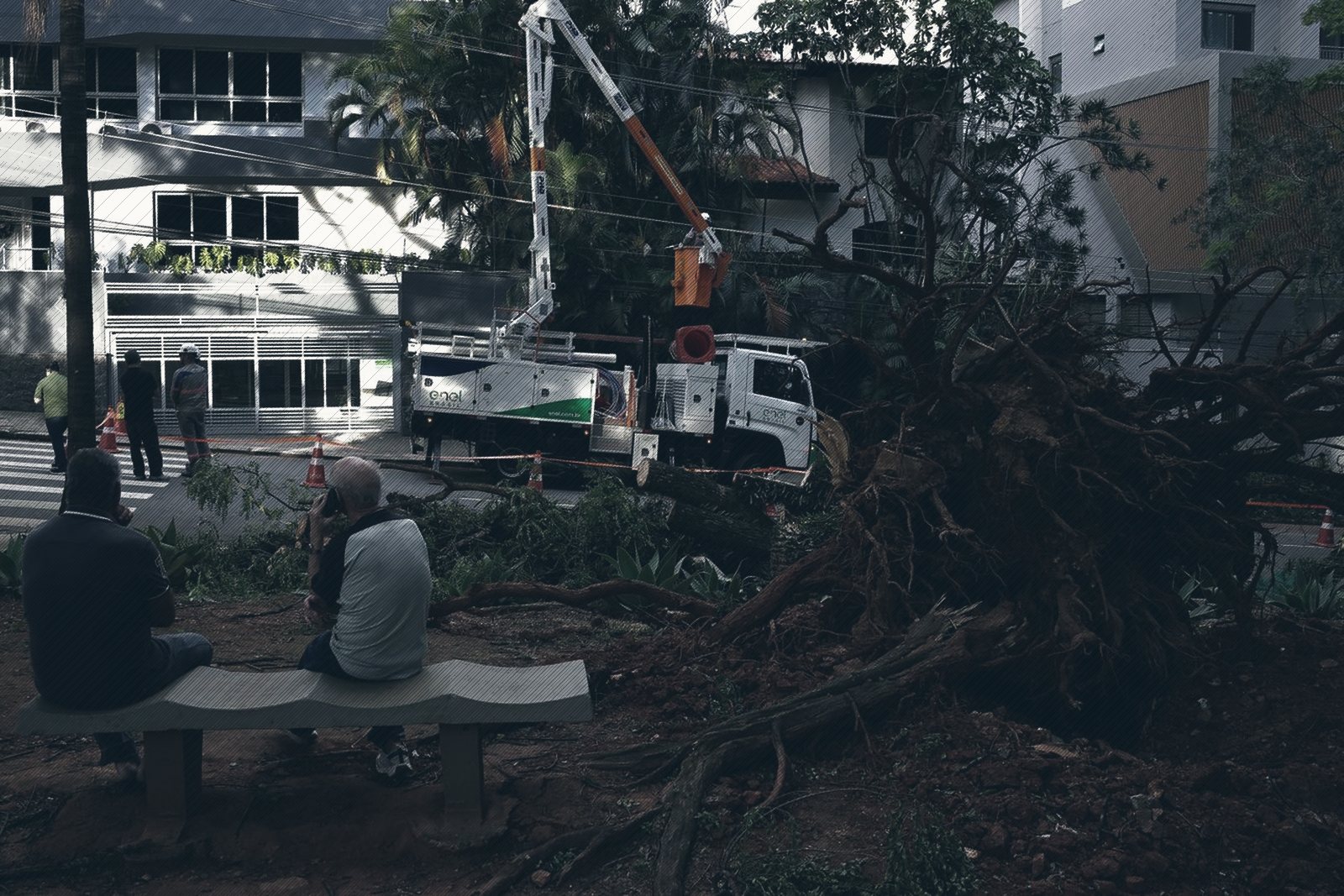
The case against Enel grew out of major storms in November 2023, October 2024 and December 2025. High winds brought down trees and lines and left millions of customers without power, some of them for several days. After the windstorm of 10 December 2025, Enel said 4.4m customers had been affected at some point; more than a million were still without electricity the following afternoon.
Aneel opened the termination proceeding in April after its own inspections found recurring failures in service quality. Its concerns centre on how the company responded to these emergencies, including delays in mobilising crews and restoring supply, and whether that met the obligations of its concession.
Enel rejects the idea that its performance justifies termination. After Tuesday's postponement it said no conclusive decision had been taken and that the extra time would allow its data and arguments to receive further technical consideration. It says it has shown the best improvement in the country in indicators such as emergency response times and prolonged interruptions, and that it complies fully with its contract and with the recovery plan it submitted to the regulator.
The distinction between the severity of a storm and the performance of a distributor is important. A utility cannot prevent extreme weather. It cannot guarantee that every line will survive unusually strong winds or that no tree will fall on its cables. But it can invest in maintenance, make its network more resilient, prepare emergency procedures and organise restoration crews.
The regulator must therefore judge not simply whether interruptions occurred, but whether the company took reasonable steps to prevent avoidable failures and to restore supply within acceptable periods. That is a more demanding test than comparing how many customers different storms affected. It requires examining the condition of the network, emergency preparedness, restoration times and the circumstances of each event.
Reliable electricity is an economic asset
Much of the debate about energy policy is about prices. Governments worry whether households can afford their bills; businesses compare electricity costs when deciding where to put factories and warehouses.
But price tells only part of the story. A country can have competitive tariffs and still impose heavy costs on business if supply is frequently interrupted.
For companies weighing an investment, reliability shapes operational planning. A manufacturer needs to know not merely what electricity will cost next year, but whether its machines will run when orders must be filled. Retailers depend on refrigeration, lighting, payment systems and communications. Logistics firms rely on working warehouses and digital systems. Even businesses that use little electricity can be badly hit when outages disrupt the services they depend on.
Economists call the losses caused by interruptions the cost of unserved energy. Measuring it precisely is difficult: a kilowatt-hour not delivered to a household at night has a different economic weight from one missing at a hospital or on a production line. The principle, however, is simple. Electricity is valuable not merely because it can be bought, but because it is there when needed.
That is why maintenance, grid modernisation and emergency preparedness should be seen as productive investment rather than mere operating expense. Their benefits mostly take the form of losses that never happen.
Would replacing the company solve the problem?
Ending a distribution concession would be a major intervention. It would signal that regulators are prepared to enforce contractual obligations when a utility's performance is judged inadequate.
That matters in a sector where consumers cannot choose another local network. Electricity distribution is a natural monopoly: it would make no economic sense to string competing sets of poles and cables along the same streets. Consumers therefore rely heavily on regulation to protect the quality of service.
But a new operator would not automatically solve the underlying problems. The physical network would remain, and so would extreme weather, urban density, ageing equipment and the practical difficulty of restoring supply across a vast metropolitan area.
A transition could also create uncertainty over future investment, contractual obligations and continuity of operations. The authorities would need to ensure that an essential service carried on without interruption and settle what arrangements would govern the network under a different operator. One director, Gentil Nogueira, has proposed a working group to assess the operational, financial and regulatory consequences of Enel's possible exit.
The economic objective is not to change the name of the company that distributes electricity. It is to build a system that delivers more reliable service, backed by clear obligations and effective oversight. Whether that can be achieved by enforcing the existing concession more firmly, or requires a new operator, is the central question in the proceedings.
Climate resilience has a price
São Paulo's experience reflects a wider challenge for electricity networks. Extreme weather can damage infrastructure that was designed and built on assumptions about the climate that may no longer hold. In dense cities, falling trees, flooding and high winds can cause complex failures that hit many customers at once.
Greater resilience requires sustained investment. Utilities may need to reinforce vulnerable stretches of network, modernise monitoring systems, manage vegetation better and install equipment that isolates damaged sections more quickly. Some lines can be buried, although that is expensive and not suitable everywhere.
Each of these involves trade-offs. Higher spending can improve reliability, but the cost must ultimately be met through some combination of company capital, tariffs and other funding. Regulators must decide how much consumers should pay for extra resilience and what improvement in service that money should buy.
The answer cannot be that networks must withstand every conceivable disaster whatever the cost. Nor can it be that consumers should accept repeated, prolonged blackouts as an unavoidable feature of city life. The goal is a reasonable balance between cost, reliability and the economic damage that failures cause. For a city of São Paulo's commercial weight, the gains from reducing major disruptions could be substantial.
Who pays when the lights go out?
The proceedings are ultimately about accountability. A private operator receives the right to provide an essential service under a regulatory contract. In return it accepts obligations on investment, maintenance and quality of service.
Consumers pay for that service, and they also bear the consequences when it falls short. The difficulty is that many of those consequences never appear in the utility's accounts. A household replacing spoiled food may not recover its losses. A small business that shuts for a day loses revenue it will never earn back. Companies that buy generators and other backup equipment raise the cost of operating in a city where reliable power should be a basic economic advantage.
When such costs become widespread, they erode competitiveness. They can also deepen inequality, because wealthier consumers and larger companies are better able to protect themselves.
Brazil's regulator must now decide whether Enel's performance and its improvement measures are adequate under the existing concession. The company's defence deserves to be weighed alongside the regulator's findings, and any final decision should rest on technical evidence, legal obligations and the likely consequences for consumers.
The wider lesson extends beyond this operator. A reliable network lets people work, businesses invest and essential services function with fewer interruptions. Its value is most visible when it fails.
São Paulo's experience shows that electricity policy cannot be judged solely by tariffs, generating capacity or the sums utilities promise to invest. The more meaningful question is what consumers receive in return. For a family opening the refrigerator after hours without power, or a shopkeeper counting another day's lost sales, that question is not abstract. It is the difference between a power system that supports economic life and one whose failures become another cost that households and businesses must learn to carry.