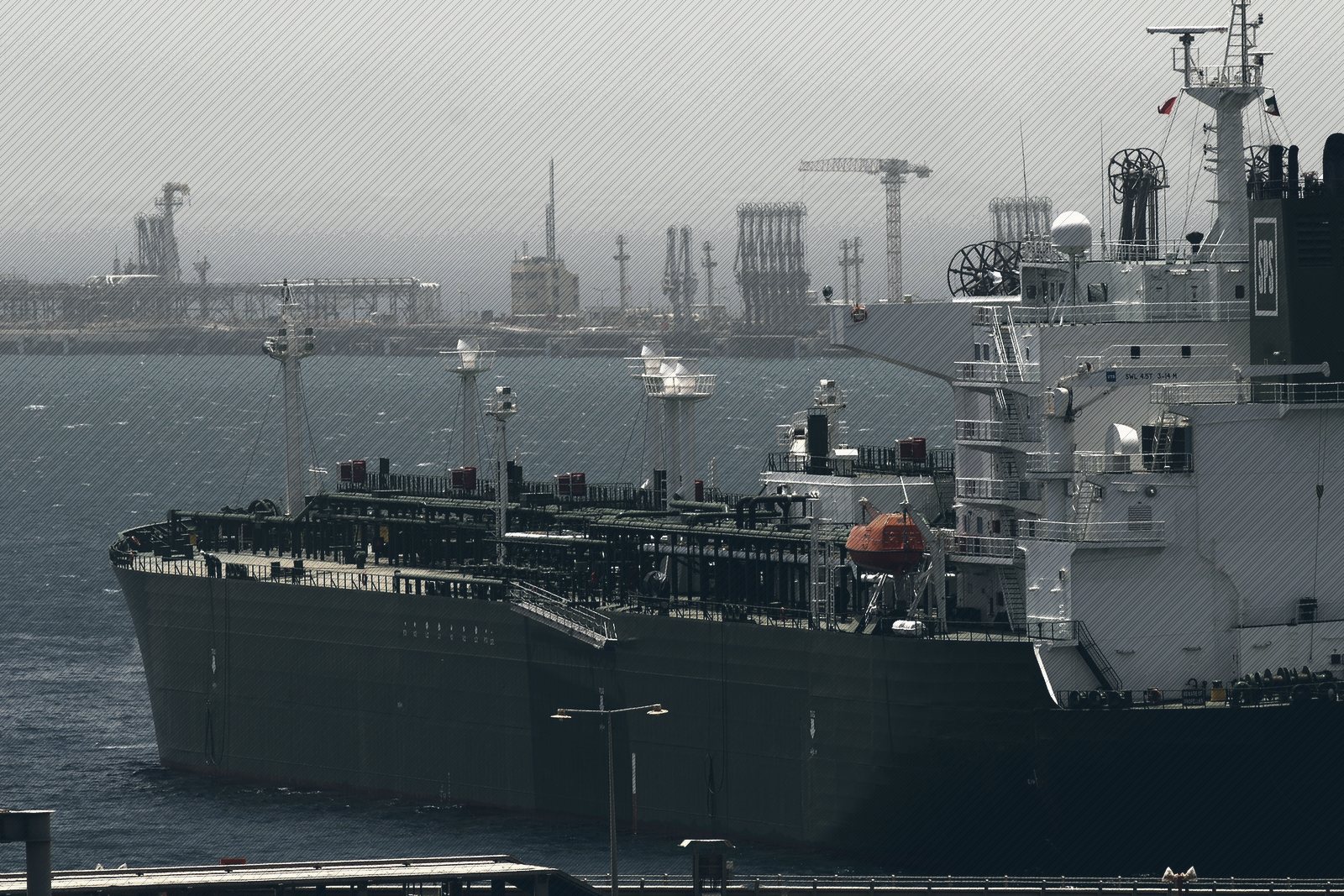
Oil prices are high, and for most producers that would be good news. Brent crude has spent much of the autumn above $80 a barrel, well above the $57 assumed in Kuwait's budget. Yet Kuwait faces the deepest recession of any major Gulf economy. The reason is geography. Almost every barrel it sells must pass through the Strait of Hormuz, and since the war with Iran began in late February, the strait has been the most dangerous stretch of water in the world.
The International Monetary Fund expects Kuwait's economy to shrink by 16.7 per cent this year, a contraction on the scale of a war economy. Allianz Research forecasts a smaller fall of 11 per cent, but describes Kuwait as the Gulf state that will see the largest fiscal deterioration from the war. Saudi Arabia, by contrast, is expected to shrink by about 3 per cent and the United Arab Emirates by between 1 and 4 per cent.
The difference is not the size of their oil reserves. It is the number of doors they have to the world.
One door, and it was shut
Saudi Arabia and the UAE spent decades and billions of dollars building escape routes. Saudi Aramco's East-West pipeline can carry up to 7m barrels a day from the oilfields of the Eastern Province to Yanbu on the Red Sea, and reached that rate in March. The UAE's Habshan-Fujairah pipeline can carry about 1.8m barrels a day to a port outside the strait. Allianz estimates that only about 30 per cent of Saudi exports and 45 per cent of the UAE's depend on Hormuz.
Kuwait has no such route. Its oil economy, Allianz notes, was built on full dependence on the strait. Hydrocarbons account for about 57 per cent of its GDP, 85 per cent of government revenue and 90 per cent of exports. When the strait closed, there was nowhere else for the oil to go.
The consequences were immediate. Kuwait Petroleum Corporation (KPC) cut production in March and declared force majeure on crude and product shipments in April. Output fell to its lowest since the aftermath of the Iraqi invasion in the early 1990s: about 740,000 barrels a day in May, according to the International Energy Agency, against an OPEC+ target of about 2.63m. It has since recovered as more tankers have risked the passage, reaching about 2m barrels a day in October, roughly three-quarters of its pre-war level.
The bill arrives
High prices cannot compensate for barrels that cannot be shipped. Kuwait's budget for 2026-27 projected a deficit of KD9.8bn, about $32bn, on revenues of KD16.3bn and spending of KD26.1bn. That was before the volume losses were counted. Allianz expects the deficit for 2026 to exceed 30 per cent of GDP.
The structure of spending makes adjustment hard. Salaries and subsidies take about 76 per cent of the budget, commitments that cannot be cut quickly without political cost.
Kuwait is fortunate to have the buffers to absorb the shock. The IMF estimated the assets managed by the Kuwait Investment Authority at about 640 per cent of GDP at the end of 2025, among the largest sovereign holdings in the world relative to the size of an economy. A debt law passed in 2025 allowed the government to borrow again after years of legislative deadlock. In July it raised $6bn in international bonds, attracting orders of more than $14.75bn despite the war.
But buffers are a way to buy time, not a strategy. Tareq Alwazzan, a researcher in oil and economic affairs, argued in the Kuwait Times last month that "sovereign wealth should support reform, not become an excuse to postpone it." Every dinar drawn from savings is a dinar meant for a future without oil.
Building a second door
The war has forced a question that Kuwait could long afford to ignore: what is it worth paying to avoid depending on a single route?
KPC has begun to answer. Its chief executive, Sheikh Nawaf Al-Sabah, said in October that the company was considering pipeline routes through Saudi Arabia and the UAE, and that it was expanding its own fleet of 29 tankers. "We found that having a strategic tanker fleet that we own is more beneficial to us," he said. Kuwait has also looked at expanding its oil storage abroad, closer to its customers.
None of these options is simple. A pipeline across Saudi Arabia to the Red Sea would run into a constraint that already limits Aramco: according to the analytics firm Kpler, the binding limit on Saudi bypass exports is not the pipeline but the loading terminals at Yanbu, where sustainable capacity is about 4.5m to 5m barrels a day. Saudi Arabia would need to expand those terminals, and to want to share them. A route to Fujairah would cross two countries and depend on the UAE, which is itself spending about $3bn to double its own bypass capacity, a project Kpler expects to come into service around mid-2027.
Any such pipeline would also take years to build and cost billions, for a risk that may recede once the war ends. That is the classic dilemma of insurance: its value is obvious in a crisis and hard to justify in calm times. The IMF's forecasts assume that the strait gradually reopens from March 2027, with pre-war conditions restored by October. If that happens, Kuwait's economy is expected to rebound by 17 per cent next year, and the case for an expensive second route will weaken in the minds of those who must pay for it.
The real lesson
The temptation will be to treat 2026 as a once-in-a-generation event. That would be a mistake. The strait has been threatened before, in the tanker war of the 1980s and repeatedly since, and the risk will not disappear with a ceasefire. Mines laid in a war can remain a hazard long after it ends: Iran's Revolutionary Guards said this week that two supertankers had struck mines in the strait.
Saudi Arabia's East-West pipeline was built in the 1980s, during the last great threat to Gulf shipping. Many considered it an expensive precaution for decades. This year it kept Saudi oil flowing and limited the damage to the kingdom's economy. Kuwait has just learned what that precaution was worth.
For a country whose wealth depends on reaching its customers, a second door is not a luxury. The question for Kuwait is not whether it can afford to build one, but whether it can afford another year like this without one.