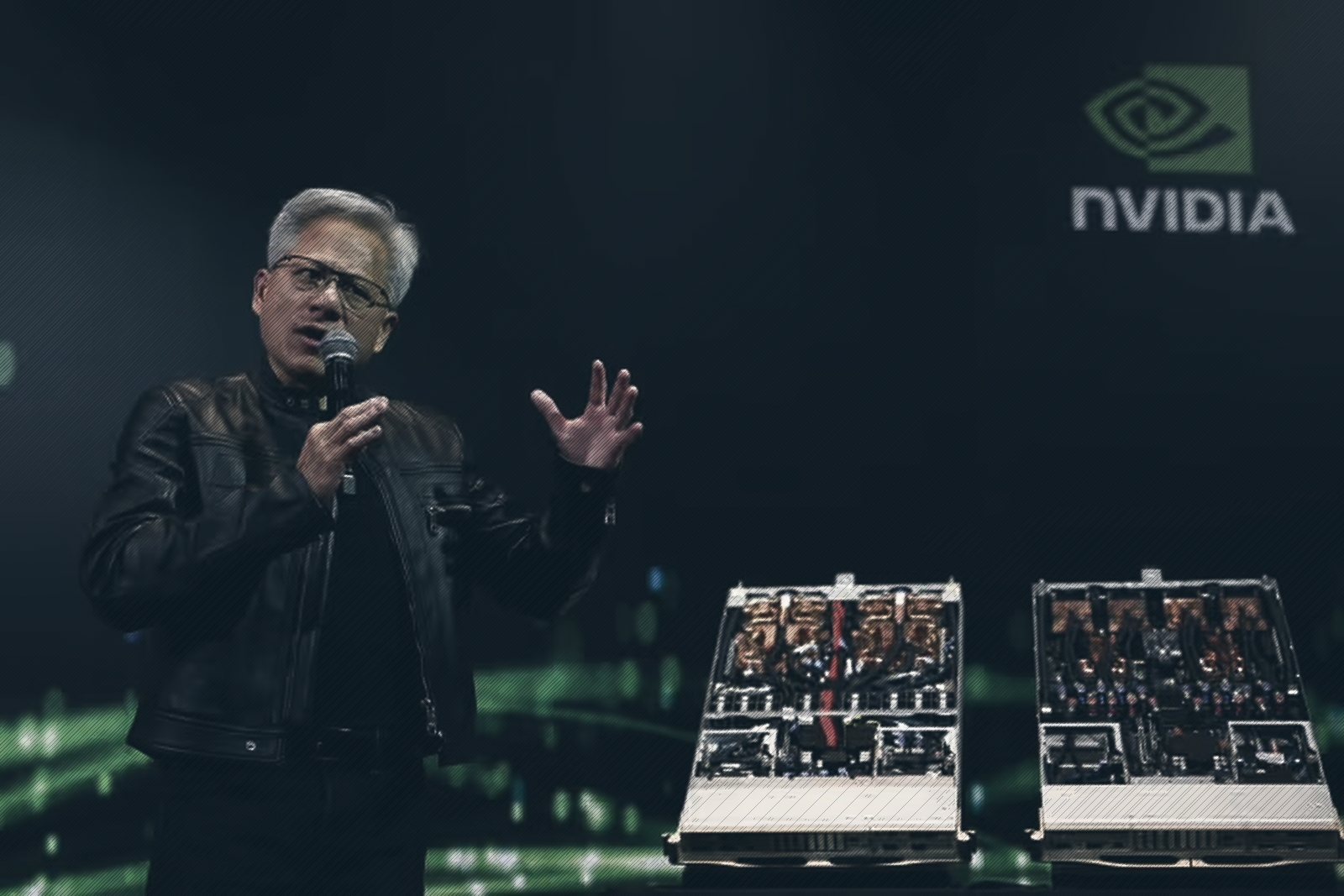
A week after Nvidia's board brought back Jensen Huang, saying it was satisfied that his return posed no national security risk, the questions that forced him out are back. Two reports in two days have put the company's chips, and the woman at the centre of the scandal, in the spotlight again.
On Thursday the Wall Street Journal reported that Nvidia had told manufacturing partners, including Dell and Super Micro, to pause shipments of its AI servers to Malaysia, Singapore, Thailand and Indonesia for an unspecified period while it checks whether customers in the region are complying with American export rules. A day later Bloomberg reported that some of Nvidia's most advanced Blackwell hardware, which cannot legally be sold to China, was running in a data centre in Shanghai linked to Alice Huang.
The racks in Shanghai
According to Bloomberg, which reviewed loan documents, two Chinese companies installed a GB300 NVL72 rack, one of Nvidia's most powerful systems, and a GB200 server at a site known as the Yangtze River Delta Project. The GB300 rack was reportedly pledged as collateral for a 96m yuan loan, about $14m, from Shanghai Innovation Bank, and the hardware also appeared in documents tied to a 90m yuan loan from a leasing company owned by a Shanghai government agency.
The site was described in 2024 as the largest data centre of Megaspeed, a Singapore company that was once an Nvidia customer and is now on a US trade blacklist and under criminal investigation over its chip purchases. Alice Huang, a Chinese citizen and former Megaspeed executive, is the woman with whom Jensen Huang admitted having a relationship when he resigned on 12 November. American intelligence agencies have concluded that she was gathering information for Beijing, according to the New York Times. The two are not related.
The reports do not establish how the hardware reached China, or that either Alice Huang or Megaspeed brought it there. Nvidia has not commented on the findings.
Closing the side door
The shipment pause follows a rule that took effect on 19 November. The Commerce Department's Bureau of Industry and Security now requires a licence to supply advanced AI chips to large data centres anywhere in the world if the customer, or its parent company, is based in China. It also imposed a separate licence requirement on exports of advanced computing equipment to Malaysia, Singapore, Thailand, Indonesia and Brazil, unless the end user is American-owned and the exporter files monthly reports.
The target is what officials call remote access. Chinese companies have been renting computing power in data centres outside China, using chips they cannot legally import. The Institute for Progress, a Washington think tank, estimates that such remote facilities supply about 24 per cent of China's AI computing power.
Who pays
For Southeast Asia, the stakes are high. The region has been one of the fastest-growing data-centre markets in the world, and Goldman Sachs expects the Malaysian state of Johor to become its largest hub by 2030. Goldman Sachs expects data centres to add an average of 0.3 percentage points a year to Malaysia's growth between 2026 and 2028, and 0.2 points to Thailand's, and expects the region's capacity to quadruple within five years. A pause of unknown length, followed by a licensing regime, threatens to slow that boom. "This would put a dampener on the demand for AI compute in existing and future data centres in South-East Asia," said Ong Kian Ming, a former Malaysian deputy trade minister.
For Nvidia, the cost is both commercial and reputational. Its shares rose by about a third on 23 November when Mr Huang returned, as investors bet that the scandal was behind it. The new reports suggest that the board's confidence may have been premature. The Securities and Exchange Commission and the Justice Department are still investigating, and the board has not published the findings of its own inquiry into whether Mr Huang was the target of a foreign intelligence effort.
What to watch
Markets reopen on Monday with three questions. How long will the shipment pause last, and will Washington issue guidance on licences quickly enough to stop it from hurting sales? Will American authorities act on the Shanghai findings, and will they ask how Blackwell hardware sold to approved customers ended up there? And will Nvidia's board, which said a week ago that it had full confidence in its chief executive, now say what it knows?