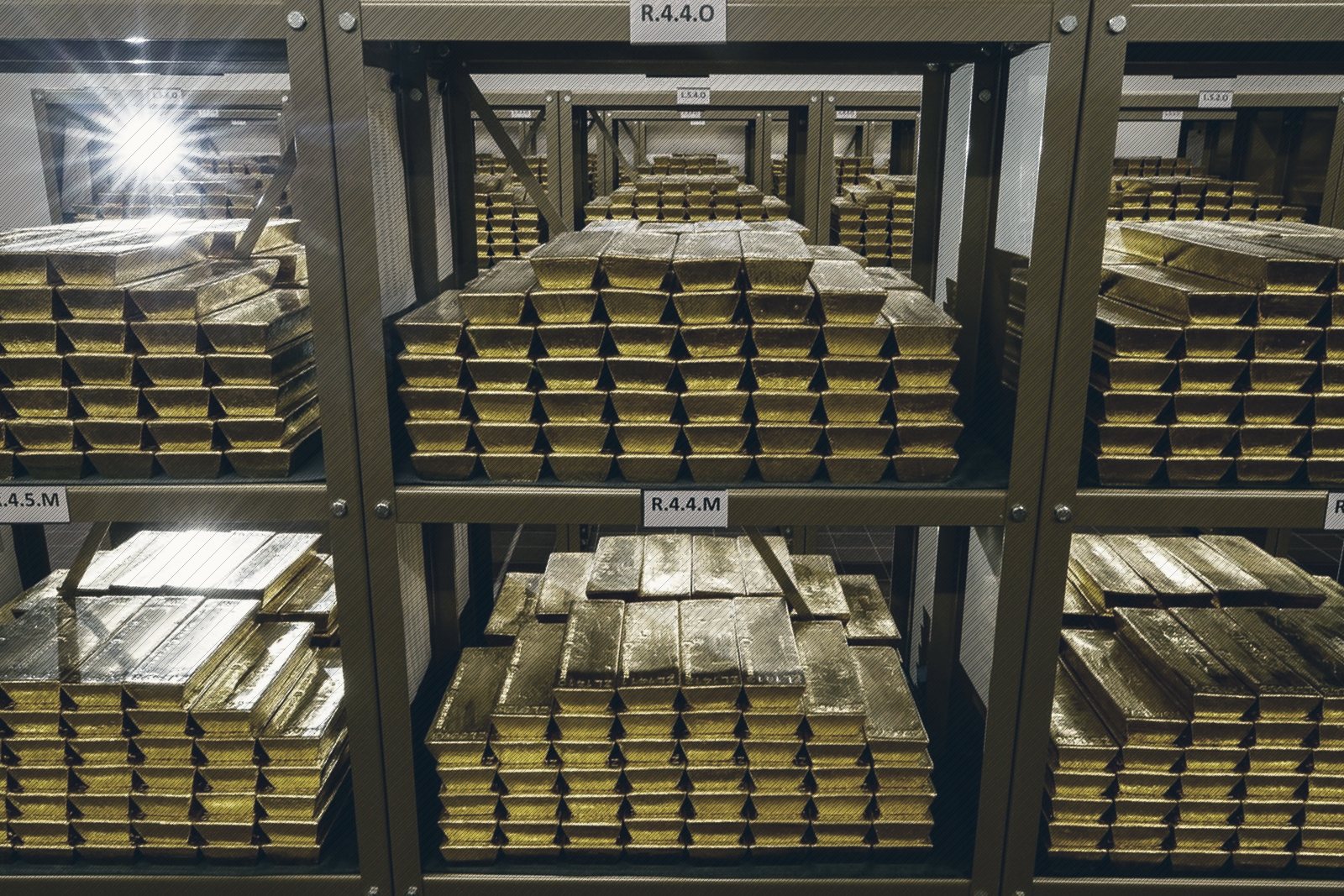
Gold has spent centuries building a reputation as a refuge from financial turmoil. Last week investors were reminded that a refuge is not necessarily a place where prices stay still.
As global stock markets fell sharply, gold fell with them. US gold futures for December delivery dropped about 4.5 per cent on Friday to roughly $3,520 an ounce, and the spot price touched its lowest level since September 2025. Over the week the metal lost about 9 per cent, its steepest weekly decline in eight months.
Government bonds moved the other way. Investors seeking shelter from the equity sell-off bought US Treasuries, pushing the yield on the benchmark ten-year note down to about 4.95 per cent.
The divergence deserves attention. Gold and government bonds are often grouped together as defensive assets, both expected to offer some protection when confidence in financial markets deteriorates. Yet in the latest sell-off they behaved very differently.
The explanation lies not in any sudden loss of gold's long-term qualities, but in the difference between preserving purchasing power and providing liquidity during a financial shock. Those are separate objectives, and a portfolio built without recognising the difference may offer much less protection than its owner expects.
A safe haven is not a promise
Investors often speak of safe-haven assets as though their protective qualities were permanent. They are not. An asset may perform well in one kind of financial stress and badly in another.
Government bonds can benefit when investors worry about growth and seek predictable income, but they lose value when inflation expectations rise or monetary policy tightens. Gold can protect against certain kinds of currency instability and doubts about the monetary system, yet it pays no income, and its price remains sensitive to interest rates, investor positioning and the availability of liquidity.
Even cash carries risk. Money in a bank account may hold its nominal value while inflation erodes its purchasing power, and currency movements can change its worth to an investor whose future obligations lie in another currency.
The word safe therefore needs a qualification: safe against what? An unexpected jump in inflation? A fall in equity valuations? A banking crisis? A currency depreciation? Or the need to meet an immediate bill? Each is a different risk, and the right protection depends on which one an investor is trying to manage. Last week showed the cost of treating them as interchangeable.
Why gold fell as uncertainty rose
Gold's weakness did not begin with Friday's sell-off. According to the World Gold Council, the metal ended October at about $3,913 an ounce, down 6.3 per cent on the month. The council suggested that much of the selling may have been derivatives-led: managed-money positions on the Comex futures exchange fell by about $7bn in October, even as global gold exchange-traded funds attracted around $3bn of inflows.
That distinction matters, because gold is bought by investors with very different aims. Central banks may hold it as part of their long-term reserves. Private investors may use it to diversify. Traders may buy futures to profit from expected price moves, often with borrowed money. These groups respond differently when financial conditions change.
When markets fall sharply, leveraged investors can face demands for more collateral. If they cannot find the cash, they may be forced to cut positions, and assets that are easy to sell become an immediate source of liquidity. Gold has a large, active international market. In normal times that liquidity is one of its strengths. During forced selling, the same quality can add to downward pressure on the price. Market commentators said last week that the stock sell-off had prompted some forced liquidation of gold positions.
An investor who needs cash may sell gold not because its long-term case has weakened, but because it is one of the things that can be sold quickly. That is the gap between a market price and an asset's intended role in a portfolio. A fall does not necessarily show that the original investment case was wrong; it may reflect the finances of other market participants. But the loss is real all the same, and an investor forced to sell at the wrong moment cannot benefit from any later recovery.
Interest rates have changed the calculation
The Federal Reserve has added another source of pressure. Expectations of further US rate increases, with markets pricing an almost certain quarter-point rise in December, have made interest-bearing assets more competitive with gold.
Gold pays no coupon or dividend; its return depends almost entirely on changes in its price. When high-quality bonds offer attractive yields, investors must weigh the opportunity cost of holding an asset that provides no regular income. That cost bites hardest when inflation-adjusted interest rates are high, because a positive real return on a government bond offers a degree of protection that does not depend on future price gains.
The comparison is not straightforward. Conventional bonds remain exposed to inflation, and their prices move as yields change; a bond held to maturity carries different risks from one that may have to be sold before it is repaid. Even so, substantial interest income changes portfolio decisions. A few years ago investors could justify holding a non-yielding asset partly because many government bonds returned next to nothing. That argument is weaker when government debt pays meaningful income.
None of this means higher rates will always push gold down. Currency movements, geopolitical risk, central-bank buying and shifts in investor confidence can all offset the effect. It does mean gold must compete with alternatives whose expected returns have changed.
Why Treasuries held up
US government bonds provide the other half of the story. During Friday's sell-off the ten-year yield fell as investors bought securities widely regarded as liquid and relatively secure. Since bond prices move inversely to yields, prices rose.
The rally came despite continuing expectations that the Fed will raise short-term rates to contain inflation. There is no contradiction. Investors can expect a central bank to keep policy tight while growing more worried about future growth. If weaker conditions lower the expected path of rates over time, longer-dated bonds become more attractive.
Treasuries also benefit from their place in the financial system. They are widely used as collateral, held across institutional portfolios and traded in exceptionally deep markets, which gives them qualities that go beyond their yield.
Their recent performance should not breed complacency. A long-dated bond remains vulnerable to a renewed rise in yields, and an investor who needs cash before maturity can lose money even when the government meets every payment. Creditworthiness and price stability are not the same thing. That matters especially for private wealth, where the timing of future liabilities can count as much as the credit quality of the assets held.
The danger of confusing diversification with protection
Gold is commonly included in diversified portfolios because its returns can differ from those of equities and bonds. The principle is sound: assets exposed to different economic forces reduce a portfolio's dependence on any single source of return.
But diversification does not guarantee that losses will be avoided in a severe sell-off. Correlations between asset prices are not fixed. They shift as inflation expectations, interest rates, financial conditions and investor behaviour change, and an asset that held up in earlier bouts of uncertainty may fall alongside equities when the nature of the shock is different.
That is what made last week instructive. Investors nursing losses on technology stocks also faced sharp falls in gold and other metals. The assets were different; the pressure to cut exposure and raise cash was not. In such conditions a portfolio can suffer simultaneous losses across holdings that once seemed unrelated.
This does not invalidate diversification. It shows why portfolios must allow for the possibility that relationships seen in ordinary markets will behave differently under stress. A plan built entirely on historical correlations is vulnerable when those correlations change just as protection is needed.
The role of liquidity in preserving wealth
For private investors, the most immediate lesson concerns liquidity.
Consider a family office with long-term investments, property and substantial future obligations. Measured by total assets, its position may look strong. But if most of those assets cannot be sold quickly without a discount, that wealth offers little flexibility in a period of stress. The same problem arises when a portfolio holds enough assets in theory but too little accessible money to meet near-term commitments.
The ability to meet obligations without forced sales is a central part of financial resilience, and it is routinely underestimated in rising markets. When prices climb steadily, investors grow comfortable with larger positions in volatile or less liquid assets, and their apparent success makes the cost of holding liquidity seem needlessly high.
A market fall changes that calculation. Cash that looked unproductive during a long rally becomes valuable because it allows bills to be paid without selling other investments at depressed prices.
That does not make cash always preferable. Inflation erodes it, and too much liquidity drags on long-term returns. The aim is not to hold as much cash as possible, but to keep the structure of assets matched to the timing and currency of future liabilities. That is a more practical definition of financial security than the search for an asset whose price is expected to rise whenever markets turn nervous.
The currency question cannot be ignored
International investors face a further complication. Gold is generally priced in dollars, but investors measure their wealth in their own currencies.
A Swiss investor holding gold must consider not only the dollar price of the metal but also the exchange rate between the dollar and the franc. The same applies to investors whose obligations are in euros, sterling or anything else. An investment can rise in dollar terms while delivering a smaller gain, or even a loss, once converted into the investor's home currency. The reverse can also happen.
This matters most when an asset is meant to protect a specific future expense. A portfolio intended to fund retirement in Switzerland has different currency needs from one meant to pay for a property in London or a business investment in the United States. Currency diversification can reduce some exposures while introducing others. The point is to understand those exposures, rather than assume that an internationally recognised asset automatically protects in every currency.
The test comes before the crisis
There will be plenty of debate about whether gold's latest fall is a temporary correction or the start of a longer adjustment. Some banks still expect higher prices: Goldman Sachs has forecast gold at $4,560 an ounce in 2027. But a single week's trading cannot settle the question. The balance between interest rates, physical demand, investor positioning and wider financial conditions may shift again. Gold could recover. It could also stay under pressure.
For long-term investors, trying to call the next short-term move is less useful than understanding why the asset is held in the first place. An investment intended to preserve purchasing power over decades should not be judged on five trading sessions. Equally, it should not be expected to provide instant liquidity at a stable price in every market upset.
The purpose of each holding must be clearly defined. Some assets are meant to generate income. Others provide exposure to growth, reduce dependence on particular currencies or preserve the ability to meet near-term obligations. A resilient portfolio recognises that no single investment can do all of these things equally well.
Last week's fall did not show that gold has stopped being valuable as a long-term reserve asset. It showed that even established stores of value remain exposed to the conditions of financial markets. The point may seem elementary, yet investors keep rediscovering it only after prices have fallen.
Wealth is not preserved by assembling a collection of assets traditionally labelled safe. It depends on understanding what each asset can protect, what it cannot and when it may have to be sold. Gold remains an important financial asset. But the greatest source of security in a portfolio is not necessarily the metal in the vault. It is the ability to withstand bad conditions without being forced into the wrong decision at the wrong time.