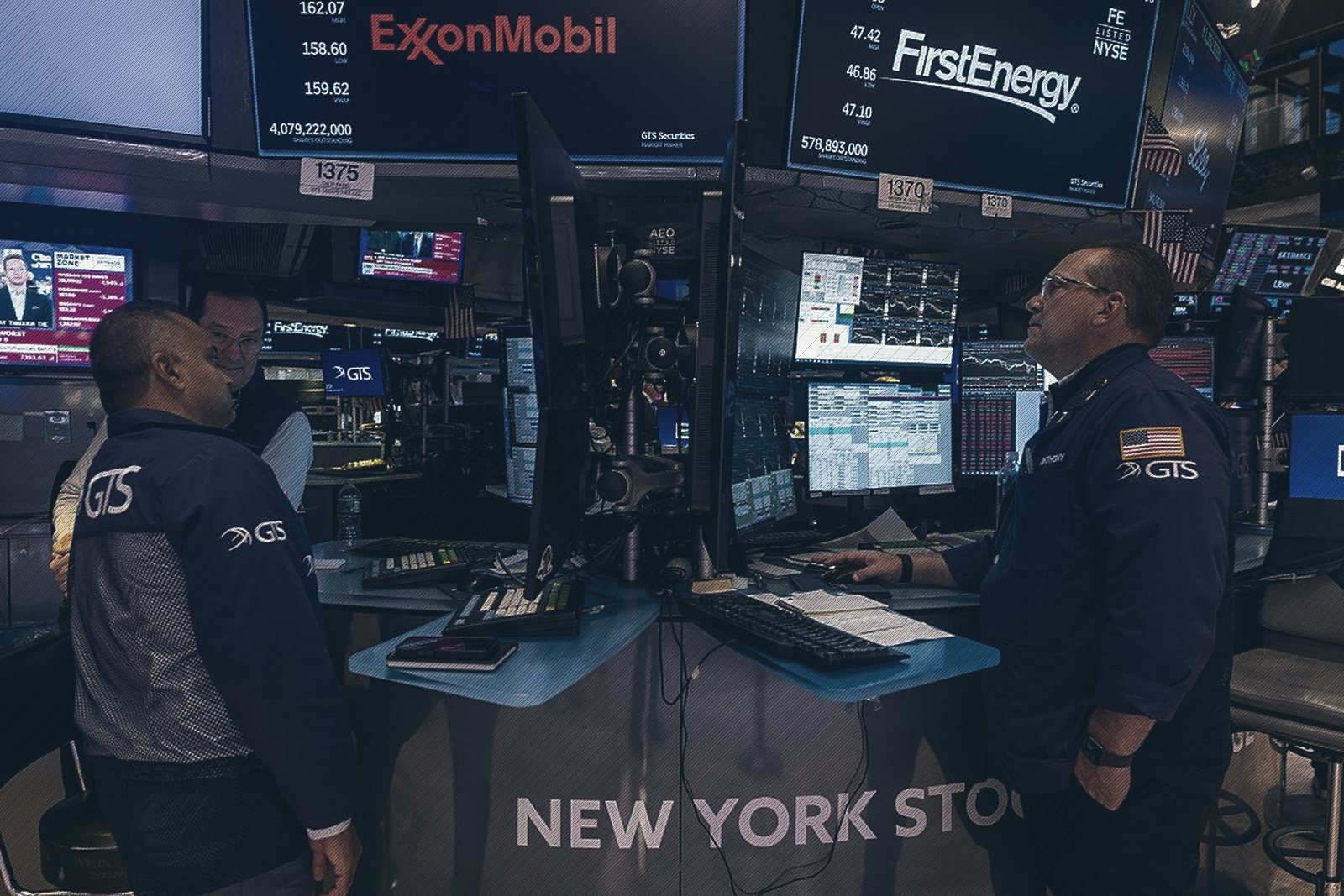
Nvidia reported $115.8bn of quarterly revenue on Tuesday, more than twice what it made a year earlier. By Friday's close its shares had fallen another 14 per cent in a single day.
That is the kind of contradiction that confuses anyone who believes the stock market is a simple scorecard of corporate success. It isn't.
Nvidia's business kept growing at a remarkable pace. Data-centre revenue reached $107.6bn, up 110 per cent from a year earlier. Gross margins held at almost 75 per cent. By almost any conventional measure, these were extraordinary results.
Investors sold anyway. By Friday the S&P 500 had fallen 8.6 per cent for the week, its worst week since April 2025. The Nasdaq 100 lost 10.4 per cent, its worst since March 2020, and the Nasdaq Composite erased its gains for the year. The S&P 500 ended the week in correction territory, more than 10 per cent below its recent peak.
The immediate explanations were many: worries about the cost of AI infrastructure, renewed expectations of higher interest rates and a reported regulatory investigation into Nvidia. But the larger problem had been building for months. Wall Street had come to expect so much from a small group of companies that exceptional performance was no longer enough to justify their valuations.
Investors were not necessarily questioning whether artificial intelligence will become an important technology. They were questioning how much to pay today for profits that may arrive years from now. That is a much harder argument to settle.
Good companies can be expensive investments
There is a distinction every investor eventually learns, sometimes at considerable cost: a company's commercial prospects and the attractiveness of its shares are not the same thing. A business can raise revenue, widen its margins and dominate its industry while still disappointing shareholders who bought at too high a price.
The reason is elementary. A share price is the present value investors assign to future earnings and cash flows, not a reward for last quarter. When expectations are modest, a company can beat them without doing anything extraordinary. When expectations become extravagant, even remarkable growth may fail to satisfy.
Nvidia's results illustrate the second problem. Revenue more than doubled, yet investors were left asking whether the company can keep up its pace, protect its margins and go on benefiting from its customers' enormous capital spending. Those are reasonable questions. The largest technology companies have committed vast sums to data centres, computing equipment and the power infrastructure behind them. For Nvidia, that spending is revenue. For the companies doing the spending, it is a cost that must eventually be recovered from customers willing to pay for what they build.
The difference matters. Selling the equipment for an emerging industry can be extraordinarily profitable. Building an industry around that equipment does not guarantee that every participant will earn a good return. The market is starting to examine that distinction more carefully.
The cost of money is back in the conversation
For much of the AI boom, investors focused on the size of the opportunity. How many data centres would be built? How much computing power would companies need? How quickly would AI become indispensable? Those questions still matter. But the price of financing the expansion has become harder to ignore.
Minutes of the Federal Reserve's October meeting, released on Wednesday, showed that almost all officials expected further rate increases to be appropriate. The Fed held its policy rate at 3.75 to 4 per cent in October after raising it in September. Its next meeting is on 8 and 9 December.
The Fed is responding to persistent inflation. It is not obliged to protect share prices. That may disappoint investors who spent years assuming that a severe enough sell-off would eventually bring easier money.
The arithmetic is less forgiving. Higher interest rates reduce the present value of earnings expected far in the future, and they raise financing costs for companies undertaking large capital projects. That matters particularly for an industry that must invest heavily long before the revenue arrives. A company building a data centre cannot pay for it with a forecast of future demand. It needs actual capital, and that capital has a price. When the price rises, projects that looked attractive in easier times become less compelling.
Artificial intelligence may transform the economy. It does not repeal the relationship between interest rates, capital spending and investment returns.
A bond rally is not a promise from the Fed
Friday produced another revealing development. As technology shares plunged, investors moved into Treasuries, and the ten-year yield fell to about 4.95 per cent, its fifth straight daily decline, even though markets still expect the Fed to raise short-term rates in December.
There is no necessary contradiction. Short-term rates reflect central bank decisions and the immediate inflation outlook. Long-term yields also reflect expectations for growth and inflation, and demand for safe assets. When investors grow nervous, government bonds can attract heavy buying even while policymakers remain determined to contain inflation.
Falling yields therefore do not mean the Fed is preparing to change course, nor should every move in bonds be read as a reliable forecast of recession. What Friday's trading showed was a change in risk appetite: investors were less willing to hold richly valued shares and more willing to accept the returns on government debt.
That is hardly new. Markets periodically rediscover that an uncertain promise of future growth is not always worth more than a relatively predictable stream of income. The rediscovery can be painful when it happens quickly.
The investigation adds another risk
The week also brought a regulatory cloud. The Wall Street Journal reported on Tuesday, citing people familiar with the matter, that the Securities and Exchange Commission is investigating Nvidia following Jensen Huang's resignation as chief executive.
It is important to distinguish an inquiry from a finding of wrongdoing. Investigations can end without enforcement action, and the available reporting does not establish that Nvidia has done anything wrong. Investors should be equally careful about reading conclusions into the share price.
But uncertainty has a financial cost even before any investigation concludes, because it affects what investors are prepared to pay. When a stock is priced for exceptional performance, fresh questions about governance, reporting or regulation can produce a disproportionate reaction. That is not necessarily irrational. A company with modest expectations built into its price has room to disappoint. A company expected to be nearly perfect has much less.
What happens after a bad week?
The temptation after a fall of this size is to hunt for the bottom. That is usually unproductive. A correction in the S&P 500 and one of the Nasdaq's sharpest weekly losses in years deserve attention, but they do not tell us what comes next. Sharp declines can create attractive valuations. They can also be followed by further falls if earnings expectations keep weakening.
A stock that has fallen a long way is not necessarily cheap. The questions that matter are whether its expected earnings remain credible, whether its balance sheet can withstand tighter conditions, and whether today's price offers enough compensation for the risks. Measuring how far it has fallen from its peak is no substitute for that judgement.
Nor should one week define an investor's view of the wider economy. American companies are still generating substantial profits, and AI investment remains an important source of demand for equipment, construction and electricity. Lower valuations do not erase economic activity already under way. But strong activity does not guarantee good investment returns either.
The market had come to depend on the assumption that AI spending would keep expanding and that the rewards would eventually justify the prices paid for the companies involved. This week's selling suggests investors are less willing to treat that outcome as inevitable. It does not prove the boom is over. It shows that confidence alone is no longer enough to hold valuations up.
The question Wall Street should have asked earlier
The essential mistake in speculative markets is rarely a complete misunderstanding of the technology. More often it is paying too much for something that turns out to be genuinely valuable. The internet changed the global economy; that did not save investors in many internet companies from enormous losses at the start of the century. The technology was real. The valuations were another matter.
Artificial intelligence may bring changes of comparable significance, raising productivity, reshaping business models and creating new industries. None of that guarantees that today's shareholders will capture the benefits at an attractive price. Investors still need to separate three different judgements: a promising industry, a successful company and a sensible investment.
Nvidia's revenue growth makes a persuasive case for the strength of demand for AI computing. It does not, on its own, settle what Nvidia's shares are worth, and the same is true across the market.
After a week like this, the sensible response is neither to declare the end of artificial intelligence nor to assume that every falling technology stock is a bargain. It is to ask what the market was pricing in, how those expectations have changed and whether the likely returns justify the uncertainty that remains.
Wall Street spent years rewarding companies for promising an extraordinary future. Now it is asking what that future will cost. It should have asked much earlier.