
On 4 November, 458 members of France's National Assembly voted against the revenue section of the government's 2027 budget. Not one deputy voted in favour. The text had been heavily amended in debate, and each political group had its own reasons for opposing it. The result was still remarkable: an entire chamber rejected a budget without agreeing on what should replace it.
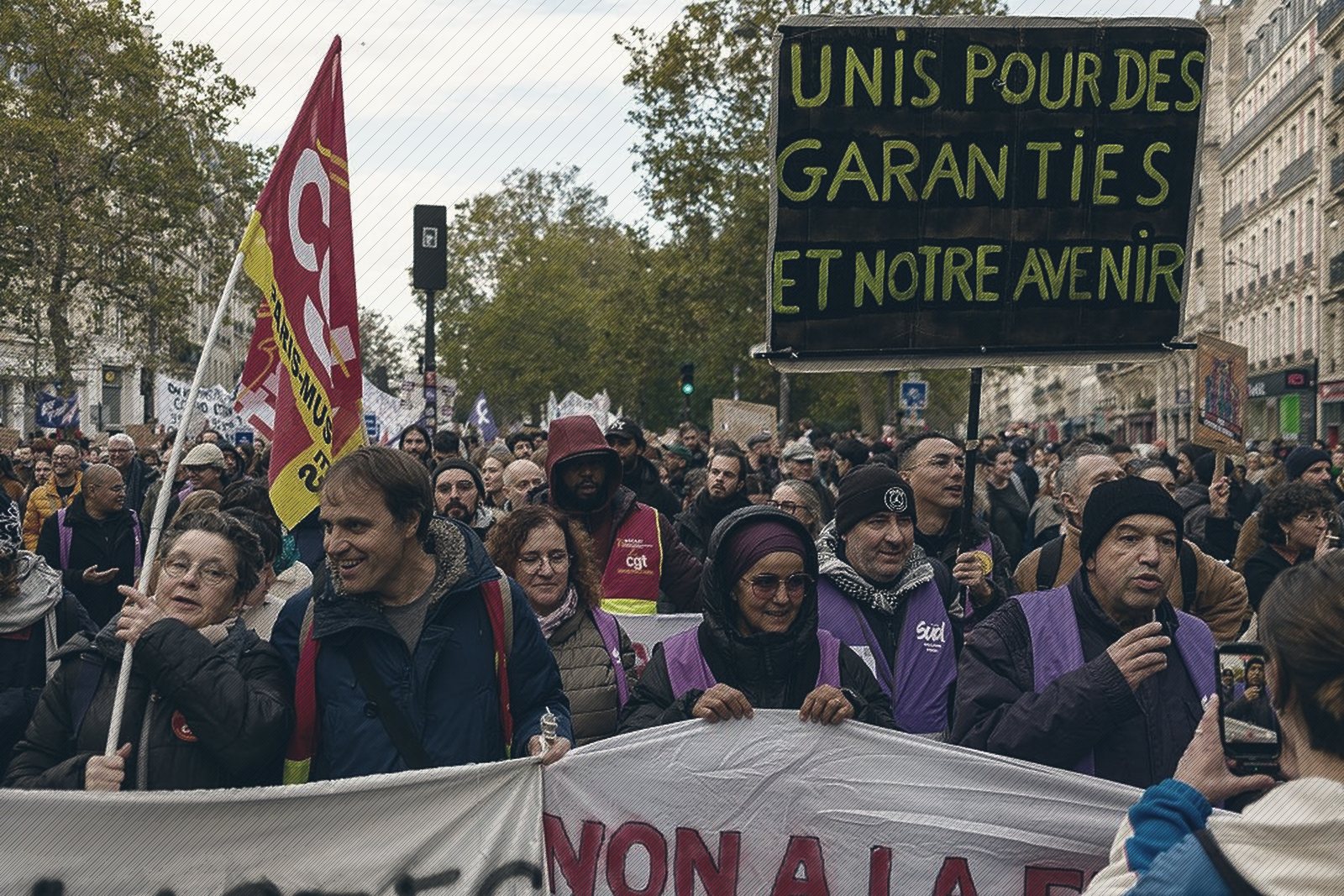
The next day, hundreds of thousands of people marched through French cities. The interior ministry counted about 600,000; the unions claimed more than 1.5 million. They demanded better wages, lower living costs and stronger public services.
The two events belong to the same economic story. France has reached a point at which what citizens expect of the state is becoming hard to reconcile with the resources available to pay for it. People want protection from rising prices, reliable healthcare, adequate pensions and decent public services. The government must contend with weak growth, rising interest payments and a level of debt that leaves little room for new commitments.
Neither side is imagining its problem. The difficulty is that the two problems cannot be solved separately. The French social model was built on the principle that prosperity should pay for collective security. Its present predicament is that collective security has become harder to finance just when citizens feel they need it most.
This is not simply a budgetary dispute. It is a dispute over the terms of the social contract.
The arithmetic behind the discontent
France's public finances have been under strain for years, but the latest forecasts show how little room is left. The European Commission's spring 2026 forecast expected growth of just 0.8 per cent this year and 1.1 per cent in 2027. On unchanged policies, it saw the deficit rising from 5.1 per cent of GDP in 2026 to 5.7 per cent next year, and public debt climbing from 115.6 per cent of GDP in 2025 to more than 120 per cent by 2027.
These are forecasts, not fate. The government's budget was designed to beat them, with a deficit target of 5 per cent for 2027. But they show the problem facing policymakers. When an economy grows slowly, revenue struggles to keep pace with spending. Debt accumulates, interest takes a larger share of the budget, and the room to respond to the next crisis narrows.
Borrowing is not wrong in itself. Governments can reasonably borrow for infrastructure and other investments whose benefits last for generations, and a high debt ratio does not on its own mean a country is heading for collapse. The more useful question is what the extra borrowing buys. Debt that pays for productive investment can strengthen the economy's capacity to repay it. Debt that year after year covers the gap between current spending and insufficient revenue is a harder proposition.
France will not settle that question by treating every spending cut as an attack on solidarity, or every tax rise as proof of responsibility. What matters is what is cut, what is taxed and how each choice affects future growth. That is exactly where the political consensus has broken down.
A welfare state without an easy source of money
The government's original 2027 proposals sought savings in several politically sensitive areas. They would have limited the inflation uprating of basic pensions above about €1,260 a month, cut the 10 per cent tax allowance available to retirees, trimmed health spending and reduced some exemptions from employer social charges. The pension measure alone was expected to save about €4.1bn in 2027, and the health measures about €3.9bn net.
These were proposals, not settled reforms, and the Assembly's vote showed how hard it has become to turn fiscal goals into law. The original text now goes to the Senate, which is due to vote on 9 December.
For those defending social protection, the objection is understandable. Pensions are not merely a line in the national accounts; they are income on which millions have planned their retirement. Health spending supports services whose value cannot always be measured in immediate returns. And workers facing higher living costs have little reason to welcome policies that cut their purchasing power.
But the state has another obligation, less visible and no less important: to ensure that the promises it makes today can be kept tomorrow. A social model financed increasingly by borrowing shifts part of the burden onto future taxpayers. If that borrowing also raises the cost of financing public services, the burden grows.
There is no simple moral line between those who want to preserve existing benefits and those who insist on restraint. Both make legitimate claims about fairness. The real conflict is over how costs are shared between generations, income groups and economic interests, and France has yet to reach a lasting agreement on that.
The limits of buying social peace
The government's response to the protests shows how narrow its options are. After talks with unions and employers on 9 November, Prime Minister Sébastien Lecornu announced that the minimum wage would rise by 1.6 per cent from 1 December, a month ahead of the usual annual adjustment, and the first discretionary increase since 2012. The monthly net minimum wage will reach about €1,502, roughly €24 more.
For a worker struggling to pay for transport, food or rent, the extra money is not trivial. Yet it falls well short of what the main unions wanted: the CFDT had sought about €100 a month and the CGT about €150. The CGT's Sophie Binet dismissed the package as "crumbs".
It also shows the limits of using wage policy to fix a broader problem of living standards. A statutory pay rise lifts the immediate income of those who receive it. It does not raise productivity, lower housing costs or increase the supply of affordable energy. Employers must absorb the cost through some mix of margins, prices, productivity and hiring decisions. A highly productive business may manage easily; a small service company on thin margins may not.
This is not an argument against minimum wages. It is a reminder that the link between incomes and economic performance cannot be settled by decree. The government can shape how income is distributed. It cannot legislate into existence the productive capacity needed to sustain rising living standards. That takes investment, innovation, effective institutions and an economy that gets more value from its resources. Such changes take years; political pressure demands results within weeks.
The forgotten condition of solidarity
The French welfare state grew from a conviction that economic citizenship should extend beyond the market. Healthcare, social insurance and protection against poverty were not conceived as acts of generosity, but as the foundations of a stable and productive society. That tradition remains one of France's defining achievements.
But the legitimacy of collective provision also depends on the credibility of its financing. Citizens must believe that their contributions are shared fairly, that public spending achieves something, and that the burden left to future generations is manageable. When that confidence weakens, a fiscal problem becomes an institutional one.
Taxpayers ask what they get in return. Beneficiaries fear the erosion of established protections. Businesses worry about the cumulative cost of tax and regulation. Governments reach for temporary compromises that postpone the conflict rather than resolve it. Each position may be rational on its own. Together they produce an economy in which almost every important reform meets resistance and almost every existing commitment becomes untouchable.
France's difficulty, then, is not simply that its state is large. A large state can coexist with prosperity when institutions work, revenues are stable and public money is used well. Nor are lower taxes on their own the answer: cuts not matched by credible spending decisions would simply recreate the financing problem in another form.
The deeper task is to restore confidence that the obligations of the state, the resources of the economy and the expectations of citizens can be brought into line. That requires a clear account of who pays, who benefits and how the economy is expected to grow. It also requires accepting that public spending is neither uniformly productive nor uniformly wasteful. Spending on education, infrastructure and effective healthcare can raise economic potential; inefficient programmes can absorb resources without delivering value. A serious debate about the French state must be able to tell the difference.
What France must decide
For decades, the great achievement of the French social model was to reconcile a market economy with an extensive system of collective protection. That reconciliation was never free of conflict. It depended on political bargaining, economic growth and a willingness to share the cost of solidarity across society.
Those conditions are now harder to sustain. Weak productivity growth limits the growth of national income. An ageing population adds pressure on pensions and healthcare. Higher borrowing costs make adjustment more expensive. And households understandably resist paying more for a state whose services many already regard as inadequate.
The political system has become adept at identifying the costs of particular reforms. It has been far less successful at agreeing on the cost of avoiding them. The rejection of the 2027 budget should be read in that light. It did not reveal fiscal difficulties France had somehow overlooked; those have been visible for years. It revealed how hard it has become to build parliamentary consent for the measures meant to address them. The protests expressed the other side of the same problem: the fear that adjustment will be imposed on households already feeling insecure.
France cannot dismiss either concern. A durable settlement will require more than agreement on next year's budget. It will require greater clarity about the services the state can provide, the contributions needed to pay for them and the reforms that can support both. Such an agreement will not end political disagreement, nor should it. But without a shared understanding of these constraints, fiscal policy risks becoming a recurring confrontation between legitimate social expectations and shrinking financial capacity.
The French state has long been the guarantor of social solidarity. Its future credibility will depend less on how much it promises to protect than on whether those promises can be kept.
A social contract is not preserved by refusing to discuss its cost. It is preserved by making sure the society that depends on it can continue to afford it.